Thursday, 6 March 2025

A guide to reading Joan Didion

Joan Didion on May 1, 1977. Her 1993 New Yorker essay “Trouble in Lakewood” still resonates.
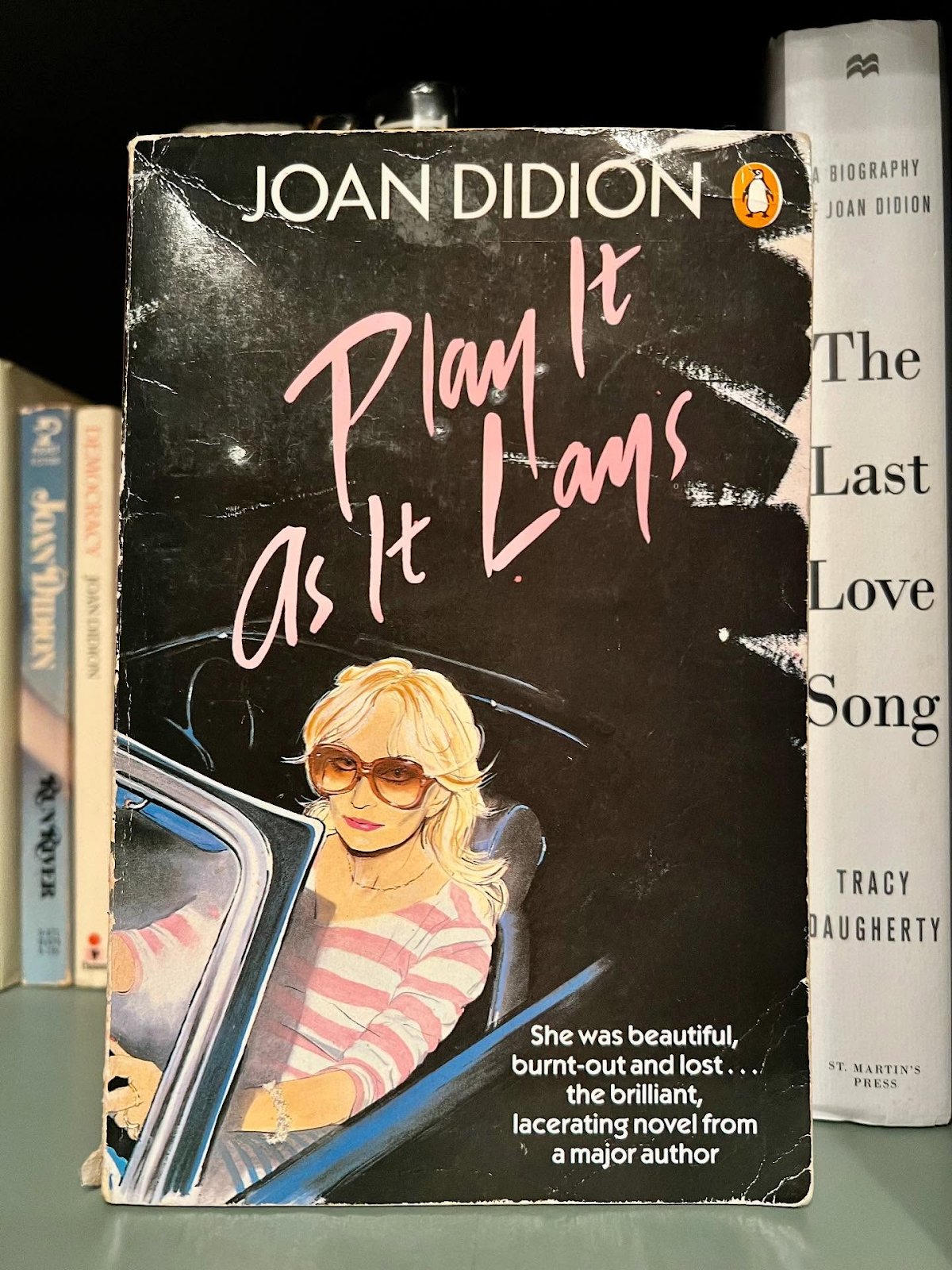
I’m a big fan of Joan Didion. I’ve read most of her published works, with her novel Play It As It Lays, Slouching Towards Bethlehem, and The Year of Magical Thinking among my favourites. What I’ve always appreciated about her writing is the precision and emotional depth she brings to her words. Few others come close. She possessed an unmatched ability to distil complex emotions and cultural shifts into sentences that feel both effortless and weighty.

Joan Didion's writing is a masterclass in precision and insight. Her distinctive style, marked by pared-down, rigorous prose, captured the nuances of American life and personal introspection. As a leading figure in the New Journalism movement of the 1960s, Didion's work blended literary flair with journalistic integrity, offering readers a profound lens through which to view the world.

Tuesday, 4 March 2025

Whatever happened to Donna Tartt?


I found a box of books in the attic yesterday, and a signed copy of Donna Tartt’s The Goldfinch was buried there. I added it to the bookshelf alongside a signed copy of The Little Friend.

I’m a massive fan of Donna Tartt, particularly (like many people) The Secret History, which I wrote about recently. It got me thinking—whatever happened to Donna Tartt?

It has been more than a decade since Tartt published her last novel, The Goldfinch (2013), which won the Pulitzer Prize and cemented her status as one of the most celebrated literary figures of our time. But since then? Silence.

Tartt has never been a prolific writer. She famously takes a decade (or more) between books, crafting intricate, deeply atmospheric novels that become instant modern classics. The Secret History (1992) and The Little Friend (2002) were each published with long gaps in between, setting a pattern of meticulous, slow-burn literary output. But now, more than ten years have passed since The Goldfinch, and there’s no official word on what comes next.

So, where is Donna Tartt? And why is the wait for her next novel taking even longer this time?

Monday, 3 March 2025

How to find your narrative voice: from first person to omniscient


Finding your narrative voice is one of the most important, and often most challenging, aspects of writing fiction.

It’s what makes your storytelling unique, setting the tone for your novel and shaping how readers connect with your characters.

However, voice is often confused with point of view (POV), the narrative perspective from which you choose to tell your story. First-person, third-person limited, or omniscient each has its strengths and challenges.

I have tried two approaches. First-person for modern fiction (both my published novels) and third-person limited for my long-paused historical novel. I am more comfortable telling a contemporary story with the former, although that style did not feel appropriate for a historical novel.

So, how do you choose the right one? And how do you develop a distinct voice within it? Let’s break it down.

Wednesday, 26 February 2025

How to write a novel when you have no time

How to write a novel when you have no time: tips and strategies to help you get the writing done.

One of the biggest challenges for most writers is finding the time. In my 20s and early 30s, I could sit for hours and devote entire weekends to writing without distractions. But life changes. Responsibilities pile up, free time disappears, and you have to adapt.

For a while, I thought I needed long, uninterrupted stretches before I could write. Otherwise, what was the point? I told myself that anything less than 90 minutes was pointless—but in reality, I was just putting blockers in the way.

I’ve since learned that writing a novel doesn’t require marathon sessions. It can be done in snatches, even 20 minutes here, a paragraph or two there.

If you feel like you don’t have time to write, you’re not alone. But that doesn’t mean you can’t finish a book. I’ve spent ages thinking about this and collected some strategies and wisdom from authors on how to write a novel when your schedule is packed.

Tuesday, 25 February 2025

Curtis Sittenfeld on Writing: Openness, routine, and authentic storytelling


I'm a huge fan of Curtis Sittenfeld, and Prep and Rodham are favourites. Her writing is always sharply observed and full of depth and memorable characters. In a recent story from The Guardian, she explores her writing process and shares how openness and authenticity influence her best-selling novels.

Monday, 24 February 2025

Publication of Joan Didion’s journal creates an ethical literary dilemma

Joan Didion has been a monumental influence on countless writers, including myself. Her works, from Slouching Towards Bethlehem to The Year of Magical Thinking, have profoundly shaped modern literature.

Anything new by her is a major literary event. So, the recent announcement of the posthumous publication of her personal journal, Notes to John, has ignited a significant ethical debate within the literary world.

Yes, it is exciting to see Didion's unpublished work, but is it right to publish her personal journals? Especially those detailing conversations with her psychiatrist?

Friday, 21 February 2025

There are no New plots: And that’s a good thing

Lee Child has now written 29 Jack Reacher novels and he famously says there are no new plots

As writers, we often hear the dreaded phrase: "Every story has already been told." It’s the kind of thought that can stop creativity in its tracks. 

However, Lee Child, the author of the Jack Reacher series (29 books and counting), sees it differently. He argues that originality doesn’t come from plot. It comes from execution.

This isn’t a problem. It’s a liberation.

Thursday, 20 February 2025

Six novels that demonstrate why “show, don’t tell” is worth getting right


When I wrote about “The art of showing, not telling” recently, I realised how many great examples of this technique exist in literature. Some authors take it to the next level, showing us emotions, relationships, and tension in ways that draw entirely us into the story without a single line of “telling.” 

I thought it might be useful to look at a few of these standout examples and the writers who have mastered the art of showing so well that their stories linger long after you’ve finished reading.

Monday, 17 February 2025

How to nail the crucial first five pages of your novel


I recently wrote about books that can help with style and craft when writing your novel, and now I want to look at those crucial first five pages. 

When it comes to capturing the attention of a literary agent, these opening pages are make-or-break territory. 

Wednesday, 12 February 2025

Dialogue that does double duty: How to advance plot and reveal character

Dialogue isn’t just there to make characters sound like they’re speaking. It’s one of the most powerful


tools in a novelist’s kit. The right line of dialogue can move the story forward, deepen a character’s personality, and sometimes even hint at future conflicts. 

When your dialogue serves multiple purposes, it pulls more weight, making your prose more efficient and engaging. Here are four well-known literary examples of how you can achieve this.

Tuesday, 11 February 2025

The art of showing, not telling: Crafting novels readers can’t put down


I've struggled with this one without knowing and have been guilty of too much telling. 

“Show, don’t tell” is one of the oldest pieces of writing advice, but what does it mean? At its core, it encourages readers to experience the story through the characters’ actions, words, and emotions instead of simply being told what to think. 

This approach makes the difference between feeling immersed in the narrative and feeling as though you’re merely reading a summary.

Monday, 10 February 2025

How to develop character backstories that bring your novel to life

Every character, even those that appear briefly, benefits from a backstory. Understanding their past not


only aids in writing them more convincingly—it also makes them feel more real, both to you and your readers. This doesn’t imply cramming pages of history into the novel, but possessing a profound understanding of their origins will manifest in subtle, impactful ways.

Friday, 7 February 2025

7 books that will help you write your novel


When I started writing, I honestly didn’t believe I could learn anything. I just sat down at my laptop, put words on the page, and wrote. No courses, advice or anything. 

In retrospect, that sounds crazy; why would you start a new project without reading about it?

Monday, 3 February 2025

Notes to John by Joan Didion


I am a huge fan of Joan Didion so this is an unexpected book treat. A new book from the much missed Joan Didion.

Sunday, 2 February 2025

Five ways to create unforgettable characters

Hercule Poirot, Agatha Christie’s brilliant detective, who combines a sharp, logical mind with a meticulous obsession over his appearance, particularly his iconic moustache.   His quirks make him stand out in a genre crowded with other sleuths. As Poirot once says in Death on the Nile:

When I think back to the characters that have stuck with me, long after I’ve closed the book, it’s not just their roles in the story that come to mind. It’s their quirks, their unique voices, and the way they seem so vividly alive. 


Creating truly memorable characters isn’t about making them flawless or heroic; it’s about giving them details, contradictions, and depth that resonate with readers. I've thought about this a lot and put together this list of 5 effective ways to create memorable characters in your writing that you might find useful when writing your novel.


Saturday, 1 February 2025

Stream-of-consciousness in novel writing: what it is and why it matters


Stream-of-consciousness writing has always fascinated me when it comes to writing novels. It can
 dive into the intricate flow of thoughts and emotions that feel unique and personal. 

Stream-of-consciousness might initially sound daunting and a bit trippy, but anyone can experiment with it.

Monday, 27 January 2025

Writing your novel: How to find your unique style

Every novelist has a unique fingerprint, a way of telling stories that sets them apart. This is your writing style, your voice. 

It's what connects you to your readers and makes your novels memorable. But how do you find it? These tips that look at finding your voice and consistency are key to getting there.

Wednesday, 15 January 2025

The 7 types of bookshelves and what it says about you


Our bookshelves provide an intimate portrait of who we are. It’s why people love a Shelfie. It's also why the so-called ‘bookshelf wealth’ trend has grown. We all have books we are proud to show, and some we might tuck away.

Apparently, there are seven common bookshelf types, ranging from the meticulous alphabetical bookshelf to the creative and eye-catching colour-coded shelf, and what each says about the people behind them.

Sunday, 12 January 2025

Richard Price on Writing: The Art of Building a World One Detail at a Time

Richard Price has long been known for his razor-sharp dialogue and immersive storytelling, whether in novels like Clockers or in his work on The Wire

In a recent interview with The Guardian, he reflected on his process—deeply rooted in observation, research, and an unwavering commitment to authenticity.

Thursday, 2 January 2025

The Young V&A Bookshop


The Young V&A
 is an inspirational, active, and fun place for kids (and adults). 

It is brilliantly curated and designed in every corner. Better still, it has a friendly little bookshop, where I came across these rather lovely-looking editions today.